The door stops moving on a Tuesday morning. You press the remote and nothing happens. You try the wall button and still get nothing. Or maybe it moves six inches and reverses, or the motor runs loudly while the door stays put. However it shows up, a garage door opener failure has a way of turning a routine morning into a stressful one.
What makes it worse for most homeowners is not the problem itself. It is not knowing what comes next. Will the tech figure it out on the first visit? Is this a quick fix or a full replacement? Those are fair questions, and walking into a repair without answers puts homeowners at a real disadvantage. Here is a full breakdown of what a professional garage door opener repair actually involves, from the first phone call to the moment the tech pulls out of the driveway.
A Proper Repair Starts Before the Tech Arrives
The quality of a garage door opener repair is often determined before anyone sets foot in the garage. A company worth calling asks the right diagnostic questions over the phone because the answers narrow down the likely cause before the visit even begins.
Is the opener completely silent, or does it hum when the button is pressed? Does the motor run while the door stays put? Did the problem start after a storm or a power flicker? Each symptom points in a different direction. A unit that hums without moving is almost always a mechanical issue inside the drive assembly. One that is completely unresponsive after a summer storm is a different conversation entirely.
At Brown’s Garage Door, every call includes a phone quote. That number is not a starting estimate. It is the price. Homeowners across Visalia and the Central Valley consistently point to this as the detail that stood out most: the price quoted on the phone matched what appeared on the final invoice, with no additions that were not discussed first.
The Door Gets Inspected Before the Opener Does
This surprises most homeowners, and it is also one of the most important parts of the job.
A garage door opener does not operate in isolation. It works alongside a spring system, a track, cables, rollers, and hardware that all affect how much load the motor carries on every cycle. An opener working against a door with a broken torsion spring, a binding track, or worn rollers is fighting resistance it was never designed to handle. Repairing the opener without addressing those conditions means the same problem returns within months.
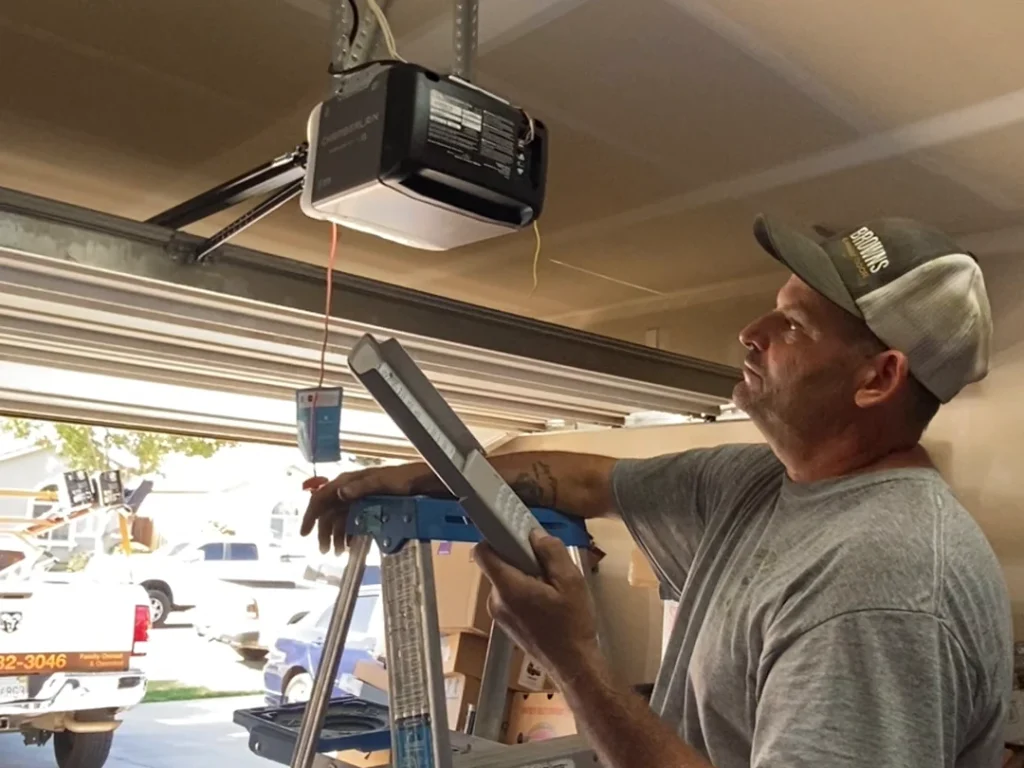
Before touching the opener, a thorough technician checks spring tension, track alignment, roller condition, hinge integrity, and whether the door moves freely when manually disconnected from the drive.
One pattern shows up regularly on calls where the opener has been out of service for a while. When homeowners do not call right away, they start hand-lifting the door to get in and out. Lifting a heavy, unbalanced door by hand puts lateral stress on the bottom brackets and cable drums that opener-driven operation does not create. By the time a technician arrives, there is often secondary wear on those components that developed entirely during that manual-operation period. A thorough inspection catches it. A rushed one does not.
The Most Common Problems Found During an Opener Repair
Once the door checks out, attention turns to the opener itself. Here are the issues that come up most frequently on professional garage door opener repair calls.
Stripped gear and sprocket kit
This is the most common finding on residential openers between five and ten years old. The motor runs and you can hear it, but the door does not move. Inside the drive assembly, a plastic gear has worn past the point of engagement with the sprocket. A gear and sprocket kit replacement is usually all it takes to restore full function without replacing the whole opener.
Logic board failure
A completely unresponsive opener with no lights, no sound, and no response from any input typically points to the logic board. It handles remote signal reception, limit settings, force calibration, and safety functions. When it fails, nothing works.
Power surges are a leading cause, and this matters in the Central Valley. Summer storm systems pushing through the San Joaquin Valley produce voltage spikes that travel through garage wiring before surge protection catches them. The logic board is always tested and confirmed as the failure point before a replacement is recommended.
Capacitor failure
Capacitor failure is one of the most consistently misdiagnosed problems in garage door opener repair, and the Central Valley climate is a direct contributor. The capacitor delivers the high-amperage burst the motor needs to start under load. When it weakens, the opener may click or hum briefly but cannot generate enough starting torque to move the door.
Sustained exposure to temperatures above 100 degrees Fahrenheit, common throughout Visalia, Tulare, and Fresno from June through September, accelerates capacitor degradation significantly. A unit that lasts 12 to 15 years in a moderate climate often shows capacitor failure in 7 to 10 years in this region. Replacing the capacitor rather than the motor saves considerable money on a repair that gets misread as something more serious far too often.
Trolley and carriage problems
When the motor runs freely but the door does not follow, the trolley assembly is the first place to look. The trolley rides the rail and transfers the drive system’s motion to the door. When it is worn or the carriage has separated from the drive mechanism, the motor runs freely but nothing transfers to the door. This is a mechanical repair and does not require replacing the opener.
Limit switch and travel setting drift
Not every opener malfunction involves a broken component. A door that opens partway and reverses, or closes most of the way and bounces back, is often a calibration issue. The limit switches define the opener’s open and closed endpoints. When those settings drift through vibration or a power interruption, the opener interprets normal travel as an obstruction and activates its reversal response. Homeowners should not attempt to correct reversal settings on a torsion spring system without proper knowledge, as interfering with safety reversal calibration creates a genuine safety risk.
How the Repair-or-Replace Decision Gets Made
For openers under ten years old with a single component failure, repair is almost always the right call. The chassis is sound and replacing one part restores full function at a fraction of replacement cost.
The calculation changes on units 15 years old or older with multiple failing components. At that service age, repair costs approach what a new unit costs, and the hardware is reaching end of life across the board.
The third factor is what the homeowner wants going forward. Modern openers offer battery backup, app connectivity, and smart home integration. Repairing an older unit keeps it running but does not add those capabilities. Brown’s Garage Door presents both options with honest numbers before any work begins. If an $80 gear kit fixes the problem, that is what gets recommended.
What a Completed Repair Looks Like Before the Tech Leaves
A garage door opener repair is not finished when the unit starts working again. Force and travel limits are tested and calibrated so the opener stops precisely at the correct positions. The auto-reversal function is tested using a physical obstruction placed under the door. Per DASMA safety guidelines, a properly functioning opener should reverse within two seconds of contact with a two-inch obstruction on the floor. Photo eye sensors are checked for alignment. The wall button and all remotes are tested.
If the unit supports app connectivity, that setup is completed before leaving. If anything on the door showed early wear during the inspection, the homeowner is informed. A $12 roller caught early does not become a $300 track repair three months later.
How Long Does a Garage Door Opener Repair Take?
Most garage door opener repairs are completed within one hour of arrival. Straightforward fixes like gear kit replacements or limit switch calibration typically wrap up in 30 to 45 minutes. Logic board replacements with full reprogramming or complete opener installations with app setup run closer to 60 to 90 minutes. If a specialty part needs to be sourced, that is communicated on the call, not discovered after disassembly. Across Brown’s Garage Door’s service area, same-day completion is the standard on the vast majority of opener repair calls.
Get Your Garage Door Opener Repaired the Right Way
A properly handled garage door opener repair means a technician who diagnoses the full system, explains findings before touching anything, completes a thorough close-out check, and leaves you knowing exactly what was done and why.
Brown’s Garage Door has been serving the Central Valley since 1994. Licensed under CSLB #1045753, with a one-year labor warranty on opener repairs. The service area covers Visalia, Tulare, Fresno, Hanford, Porterville, and nearby Central Valley communities.
Call (559) 732-3046 for a straight answer before anyone drives out.