The night before, the door worked fine. The next morning, there is a loud bang from the garage, or the door simply will not move. For homeowners across Visalia and the Central Valley, that experience feels sudden. The spring was fine yesterday. Today it is not.
Here is what actually happened: the spring was not fine yesterday. It was at the end of a gradual process that had been building for months without producing a symptom obvious enough to prompt a service call. What feels like a sudden failure is almost always the final moment of a slow one.
This is a breakdown of why torsion springs fail, what the warning signs look like before the break, and what a proper garage door spring repair involves once it does. Torsion spring repair is not a job for homeowners to attempt. The tension stored in a wound spring is substantial, and the consequences of a mistake are serious.
It Probably Was Not As Sudden As It Seemed
Every torsion spring has a rated service life measured in cycles. One cycle equals one complete open and one complete close. Standard residential torsion springs are typically rated for around 10,000 cycles per DASMA industry guidelines.
At two cycles per day, a household reaches 10,000 cycles in roughly 13 to 14 years. In a high-use household cycling four to six times daily, that same spring reaches the end of life in six to eight years. The spring does not fail at cycle 10,001. It weakens gradually through the final cycles, and the signs of that weakening are easy to miss when the door is still technically working.
By the time the spring snaps, it has already been operating in a compromised state. The snap is the end of that process, not the beginning of it.
What Actually Causes a Torsion Spring to Break
Understanding why the spring failed sets realistic expectations for the replacement.
Metal fatigue from normal cycle wear
Every time the spring winds to lift the door and unwinds as it closes, the metal undergoes mechanical stress. Over thousands of cycles, microscopic fractures develop within the coil and propagate until the coil can no longer hold tension. Stress concentrates at points of existing imperfection or surface irregularity, which is why a spring does not always fail at the most-used section of the coil. The snap is the moment the fracture completes. It is the end of a process that started long before anyone noticed.
Central Valley heat compounding wear
Sustained exposure to temperatures above 100 degrees Fahrenheit, common throughout Visalia, Tulare, and Fresno from June through September, accelerates metal fatigue beyond what standard cycle ratings account for. Thermal expansion and contraction through extreme seasonal swings compound coil stress with every passing year. A torsion spring may show failure earlier in the Central Valley than general manufacturer guidelines suggest because thermal cycling adds stress the cycle rating alone does not capture.
Rust and corrosion increasing friction
Rust that penetrates the coil increases friction as the spring winds and unwinds, concentrating wear at the corroded section and accelerating fracture development at that point. Springs in garages with poor ventilation or humidity exposure are particularly vulnerable. Regular lubrication with an appropriate product slows this process significantly.
Incorrect spring sizing at installation
A torsion spring must be sized to the specific weight of the door it counterbalances. A spring wound to the wrong tension wears unevenly from the first cycle, producing wear patterns that lead to premature failure. Spring replacement is not simply finding a spring that fits the shaft. The replacement must be sized correctly for the door’s actual weight.
Deferred maintenance
A torsion spring that is never lubricated, never inspected, and never adjusted as tension drifts reaches failure faster than one that receives regular attention. Maintenance does not prevent a spring from eventually wearing out, but it extends the time before failure and catches early indicators before the spring reaches the breaking point.
What the Warning Signs Actually Look Like
The signs that a torsion spring is approaching failure develop gradually and are easy to miss.
A low metallic groan during operation. A torsion spring in good condition operates without significant noise. A groan or creak that developed recently and was not present six months ago often indicates the coils are under uneven stress or that fractures are already affecting the spring’s behavior under load.
The door feels heavier when lifted manually. Disconnecting the opener and lifting the door by hand is one of the most reliable field assessments for spring conditions. A properly tensioned torsion spring makes the door feel nearly weightless. A door that requires real effort to lift or feels uneven from side to side means the spring is no longer providing adequate counterbalance.
The door hangs lower on one side mid-travel. A spring losing tension unevenly causes the door to sit asymmetrically when stopped partway through its travel. One corner drops lower than the other. This is one of the clearest indicators that the spring system needs professional attention before the next failure point arrives.
The opener sounds like it is working harder. The opener is designed to move a counterbalanced door, not lift the full weight of the panel. When the spring no longer provides adequate counterbalance, the opener compensates by running at higher load. Homeowners often notice this change and assume the opener is the problem. In many cases, the spring is.
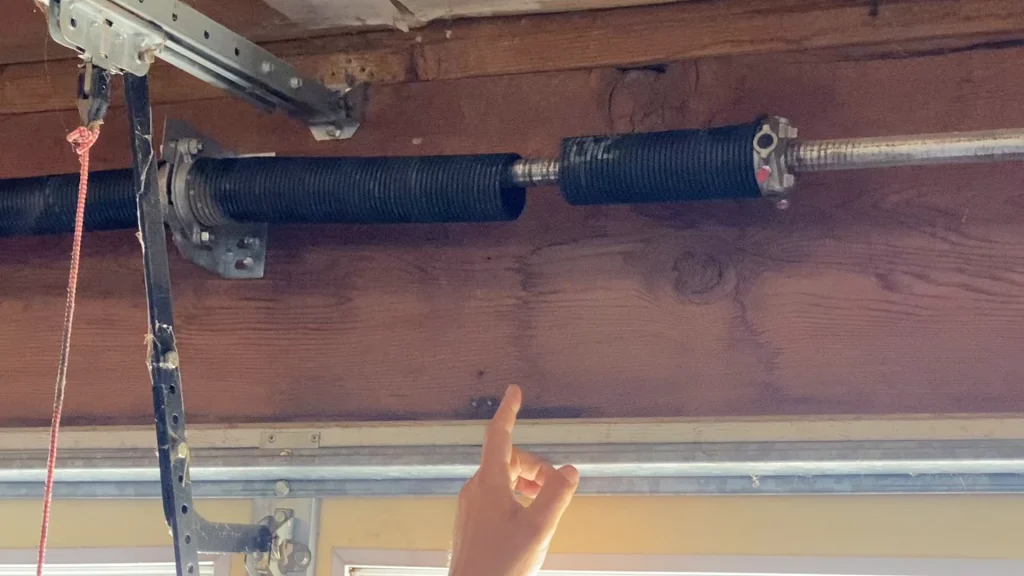
A visible gap in the coil. A gap where there was not one before means the spring has already partially or fully separated. A door in this condition should not be operated with the opener. Running the opener against a broken spring puts immediate stress on the motor, drive mechanism, and trolley.
What Happens When the Spring Breaks
A torsion spring snapping under full tension releases its stored energy instantly. The resulting sound is a loud bang, startling enough to bring people in from other parts of the house. After the sound, the door stops responding. If the spring breaks while the door is closed, the opener runs but the door does not move. If the spring breaks mid-travel, the door may drop suddenly rather than continuing its arc.
Attempting to operate the door repeatedly after a spring failure compounds the situation. Each attempt adds load to the motor, the drive gear, and the trolley carriage, none of which were designed to carry the full dead weight of the panel without a functioning spring. What began as a spring replacement can involve additional work on the opener or drive system if the door was operated repeatedly after the failure. The safest step after a spring break is to leave the door in its current position and call for service.
Why Garage Door Spring Repair Is Not a DIY Job
Torsion springs operate under significant mechanical tension. A wound spring stores enough energy to cause serious injury if it releases unexpectedly during handling.
The winding process requires specific winding bars sized to the spring’s winding cone. Using a substitute tool, anything that does not seat correctly in the winding cone, is how winding bar accidents happen. The bar slips, the spring unwinds suddenly, and the force involved does not leave much margin for error.
A technician who has performed torsion spring repair across hundreds of jobs still follows the same deliberate process every time. Experience does not change the tension stored in the spring. It changes the technician’s ability to recognize when something is not right before the next step becomes a problem.
Brown’s Garage Door handles torsion spring repair across Visalia, Tulare, Fresno, Porterville, Hanford, and the surrounding Central Valley. Every replacement includes sizing the spring to the door’s actual weight, winding to the correct tension, testing balance before the opener is reconnected, and confirming the door operates correctly before the job is closed.
How Long Does a Replacement Spring Last?
A standard residential torsion spring rated for 10,000 cycles provides several years of reliable service under normal household use. In the Central Valley, thermal cycling through extreme summer heat and cooler winters adds compounding stress that standard cycle ratings do not account for, which is why scheduled maintenance matters more here than the rated cycle life alone suggests.
Brown’s Garage Door backs torsion spring repairs with a 5-year spring guarantee and a 1-year labor warranty. To be precise: the 5-year guarantee covers the spring component. The 1-year warranty covers the labor performed during the repair. These are separate coverages with separate scopes.
Garage Door Spring Repair Across Visalia and the Central Valley
Torsion spring failure is rarely as sudden as it feels. The snap is the final moment of a process that develops over months.
Brown’s Garage Door has been handling garage door spring repair across Visalia, Tulare, Fresno, Porterville, Hanford, and surrounding Central Valley communities since 1994. Licensed under CSLB #1045753. Spring repairs are backed by a 5-year spring guarantee and a 1-year labor warranty on workmanship.
Call (559) 732-3046 for a phone quote before anyone drives out.